可能感兴趣的商品
-

品牌:Microchip Atmel
类别:ATmega系列单片机
-
品牌:Microchip Atmel
类别:ATmega系列单片机
-
品牌:Microchip Atmel
类别:ATmega系列单片机
-
品牌:Microchip Atmel
类别:ATmega系列单片机
-
品牌:Microchip Atmel
类别:ATmega系列单片机
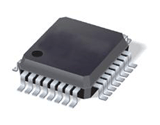
ATMEGA328P-15MZ
- 品牌:Microchip Atmel
- 包装:Tape & Reel (TR)
- 无铅情况/ROHS: 有铅
- 经营商:科通芯城自营
- 描述:8-bit Automotive AVR Microcontroller, 32KB ISP Flash, 32 Pins
- 封装:32-TQFP, 32-VQFP
- 类别:ATmega系列单片机
| 参数 | 数值 |
|---|---|
| 核心处理器 | AVR |
| NAND Interface | No |
| ADC Speed (ksps) | 15 |
| External Bus Interface | 0 |
| Input Capture Channels | 1 |
| SPI | 2 |
| Hardware QTouch Acquisition | No |
| Self Program Memory | YES |
| picoPower | Yes |
| Timers | 3 |
| EEPROM (Bytes) | 1024 |
| Flash (Kbytes) | 32 Kbytes |
| DRAM Memory | No |
| Temp. Sensor | Yes |
| 系列 | AVR® ATmega |
| USB Interface | No |
| 芯体尺寸 | 8-Bit |
| 速度 | 16MHz |
| RAM容量 | 2K x 8 |
| 程序存储器类型 | FLASH |
| 程序存储器容量 | 32KB (32K x 8) |
| EEPROM 大小 | 1K x 8 |
| 输入/输出数 | 23 |
| 振荡器型 | Internal |
| 数据转换器 | A/D 8x10b |
| 连通性 | I²C, SPI, UART/USART |
| 工作电压 | 2.7 V ~ 5.5 V |
| 工作温度 | -40°C ~ 125°C |
| 周边设备 | Brown-out Detect/Reset, POR, PWM, WDT |
| Temp. Range (deg C) | -40 to 125 |
| CPU | 8-bit AVR |
| Output Compare channels | 6 |
| Ext Interrupts | 24 |
| Pin Count | 32 |
| Analog Comparators | 1 |
| PWM Channels | 6 |
| 32kHz RTC | Yes |
| Video Decoder | No |
| ADC channels | 8 |
| SRAM (Kbytes) | 2 |
| Calibrated RC Oscillator | Yes |
| DAC Resolution (bits) | 0 |
| Crypto Engine | No |
| Operating Voltage (Vcc) | 2.7 to 5.5 |
| FPU | No |
| Camera Interface | No |
| Graphic LCD | No |
| Max. Operating Frequency | 16 MHz |
| I/O Supply Class | 2.7 to 5.5 |
| ADC Resolution (bits) | 10 |
| # of Touch Channels | 16 |
| TWI (I2C) | 1 |
| MPU / MMU | no / no |
| Resistive Touch Screen | No |
| UART | 1 |
| Max I/O Pins | 23 |
| USB Speed | No |
| DAC Channels | 0 |
The low-power CMOS 8-bit microcontroller, based on the AVR enhanced RISC architecture features 32KB ISP flash memors, 1KB EEPROM, 2KB SRAM, 23 general purpose I/O lines, 32 general purpose working registers, three flexible timer/counters with compare modes, internal and external interrupts, serial programmable USART, byte-oriented 2-wire serial interface, SPI serial port, 6-channel/10-bit A/D converter (8-channel in TQFP and QFN/MLF packages), programmable watchdog timer with internal oscillator, and five software selectable power saving modes. The device operates between 2.7-5.5 volts. By executing powerful instructions in a single clock cycle, the device achieves throughputs approaching 1 MIPS per MHz, balancing power consumption and processing speed.
| 序号 | 描述 | |
|---|---|---|
| 1 | 文档(Document) | Development Platform Evaluation Kit for Automotive Applications |
| 2 | 文档(Document) | AVR32: High-throughput 32-bit Microcontroller Architecture Addresses the Automotive Challenge of Tom |
| 3 | 文档(Document) | BLDC Motor Control for High-temperature Applications |
| 4 | 文档(Document) | BLDC Motor Control: Using Atmel AVR Microcontrollers |
| 5 | 文档(Document) | LED Automotive Lighting |
| 6 | 文档(Document) | Micro Stepping: A Smoother Way of Life |
| 7 | 文档(Document) | RF Design Considerations for Passive Entry Systems |
| 8 | 文档(Document) | The Atmel FlexRay Evaluation and Development Platform |
| 9 | 文档(Document) | Development Platform Evaluation Kit for Automotive Applications |
| 10 | 文档(Document) | AVR32: High-throughput 32-bit Microcontroller Architecture Addresses the Automotive Challenge of Tom |
| 11 | 文档(Document) | BLDC Motor Control for High-temperature Applications |
| 12 | 文档(Document) | BLDC Motor Control: Using Atmel AVR Microcontrollers |
| 13 | 文档(Document) | LED Automotive Lighting |
| 14 | 文档(Document) | Micro Stepping: A Smoother Way of Life |
| 15 | 文档(Document) | RF Design Considerations for Passive Entry Systems |
| 16 | 文档(Document) | The Atmel FlexRay Evaluation and Development Platform |
| 序号 | 描述 | |
|---|---|---|
| 1 | 文档(Document) | ATmega32M1 on MC320 BLDC/BLAC Motor Control Using a Sinus Moulated PWM Algorithm with Atmel ATmega32M1 |
| 2 | 文档(Document) | Atmel AVR32027: Mixing Assembly and C with AVRGCC This application note describes how to mix both C and assembly code in an AVRGCC project using Studio 6 IDE. The application note is written from the perspective that C is the language of choice and assembly language is included in situations where it is either necessary or convenient. |
| 3 | 文档(Document) | AVR077: Opto Isolated Emulation for the DebugWIRE This application note describes how to implement an optoisolated interface for the DebugWIRE. This device could help the debug of applications with non isolated power supply like ballast, motors, vacuum cleaners, refrigerators, etc. |
| 4 | 文档(Document) | AVR191: Anti-Pinch Algorithm Adaptation Procedure The purpose of this document is to explain how to adapt an anti-pinch algorithm to a specified powered window. |
| 5 | 文档(Document) | AVR317: Using the USART on the ATmega48/88/168 as a SPI master Some applications might need more than one SPI module. This can be achieved using the new Master SPI Mode of the ATmega48/88/168 USART. |
| 6 | 文档(Document) | AVR512: Migration from ATmega48/88/168 to ATmega48P/88P/168P This Application Note describes differences to be aware of when migrating from the ATmega48/88/168 to the ATmega48P/88P/168P Microcontroller. |
| 7 | 文档(Document) | AVR515: Migrating from ATmega48/88/168 and ATmega48P/88P/168P/328P to ATtiny48/88 This Application Note describes differences to be aware of when migrating from the ATmega48/88/168 or ATmega48P/88P/168P/328P to the ATtiny48/88 Microcontroller. |
| 8 | 文档(Document) | AVR528: Migrating from ATmega48P/88P/168P to ATmega48PA/88PA/168PA This Application Note describes differences to be aware of when migrating from the ATmega48P/88P/168P to the ATmega48PA/88PA/168PA Microcontroller. |
| 9 | 文档(Document) | AVR926: Using ATmega88 and ATA6824 for DC motor control in high temperature environment DC Motor Control in High Temperature Environment |
| 10 | 文档(Document) | AVR927: Using ATmega88 and ATA6832 for BLDC motor control in high temperature environment The purpose of this document is to explain the theory and application of Atmel's integrated BLDC driver solution. |
| 11 | 文档(Document) | ATmega32M1 on MC320 BLDC/BLAC Motor Control Using a Sinus Moulated PWM Algorithm with Atmel ATmega32M1 |
| 12 | 文档(Document) | Atmel AVR32027: Mixing Assembly and C with AVRGCC This application note describes how to mix both C and assembly code in an AVRGCC project using Studio 6 IDE. The application note is written from the perspective that C is the language of choice and assembly language is included in situations where it is either necessary or convenient. |
| 13 | 文档(Document) | AVR077: Opto Isolated Emulation for the DebugWIRE This application note describes how to implement an optoisolated interface for the DebugWIRE. This device could help the debug of applications with non isolated power supply like ballast, motors, vacuum cleaners, refrigerators, etc. |
| 14 | 文档(Document) | AVR191: Anti-Pinch Algorithm Adaptation Procedure The purpose of this document is to explain how to adapt an anti-pinch algorithm to a specified powered window. |
| 15 | 文档(Document) | AVR317: Using the USART on the ATmega48/88/168 as a SPI master Some applications might need more than one SPI module. This can be achieved using the new Master SPI Mode of the ATmega48/88/168 USART. |
| 16 | 文档(Document) | AVR512: Migration from ATmega48/88/168 to ATmega48P/88P/168P This Application Note describes differences to be aware of when migrating from the ATmega48/88/168 to the ATmega48P/88P/168P Microcontroller. |
| 17 | 文档(Document) | AVR515: Migrating from ATmega48/88/168 and ATmega48P/88P/168P/328P to ATtiny48/88 This Application Note describes differences to be aware of when migrating from the ATmega48/88/168 or ATmega48P/88P/168P/328P to the ATtiny48/88 Microcontroller. |
| 18 | 文档(Document) | AVR528: Migrating from ATmega48P/88P/168P to ATmega48PA/88PA/168PA This Application Note describes differences to be aware of when migrating from the ATmega48P/88P/168P to the ATmega48PA/88PA/168PA Microcontroller. |
| 19 | 文档(Document) | AVR926: Using ATmega88 and ATA6824 for DC motor control in high temperature environment DC Motor Control in High Temperature Environment |
| 20 | 文档(Document) | AVR927: Using ATmega88 and ATA6832 for BLDC motor control in high temperature environment The purpose of this document is to explain the theory and application of Atmel's integrated BLDC driver solution. |
| 序号 | 描述 | |
|---|---|---|
| 1 | 文档(Document) | ATmega328P Automotive Preliminary |
| 2 | 文档(Document) | ATmega328P Automotive Preliminary |
| 序号 | 描述 | |
|---|---|---|
| 1 | 文档(Document) | Automotive Compilation |
| 2 | 文档(Document) | Automotive Solutions |
| 3 | 文档(Document) | Automotive Solutions (Chinese Version) |
| 4 | 文档(Document) | AVR Microcontrollers for Automotive |
| 5 | 文档(Document) | Automotive Compilation |
| 6 | 文档(Document) | Automotive Solutions |
| 7 | 文档(Document) | Automotive Solutions (Chinese Version) |
| 8 | 文档(Document) | AVR Microcontrollers for Automotive |
| 序号 | 描述 | |
|---|---|---|
| 1 | 文档(Document) | Reference Design Based on ATR2406 and ATmega88 |
| 2 | 文档(Document) | Reference Design Based on ATR2406 and ATmega88 |
| 序号 | 描述 | |
|---|---|---|
| 1 | 文档(Document) | AVR and AVR32 - Quick Reference Guide Introduction of the product range of AVR and AVR32 microcontrollers and application processors:
|
| 2 | 文档(Document) | AVR and AVR32 - Quick Reference Guide Introduction of the product range of AVR and AVR32 microcontrollers and application processors:
|
| 序号 | 描述 | |
|---|---|---|
| 1 | 文档(Document) | Atmel QTouch Library 5.0 |
| 2 | 文档(Document) | Atmel QTouch Library 5.0 |
| 序号 | 描述 | |
|---|---|---|
| 1 | 文档(Document) | Next-Generation IDE: Maximizing IP Reuse |
| 2 | 文档(Document) | Next-Generation IDE: Maximizing IP Reuse |
| 序号 | 描述 | |
|---|---|---|
| 1 | 文档(Document) |
Automotive: 微控制器, 网络连接