可能感兴趣的商品
-

品牌:Microchip Atmel
类别:ATmega系列单片机
-
品牌:Microchip Atmel
类别:ATmega系列单片机
-
品牌:Microchip Atmel
类别:ATmega系列单片机
-
品牌:Microchip Atmel
类别:ATmega系列单片机
-
品牌:Microchip Atmel
类别:ATmega系列单片机
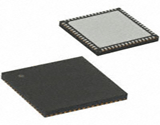
ATMEGA169P-15MT
- 品牌:Microchip Atmel
- 包装:Tape & Reel (TR)
- 无铅情况/ROHS: 有铅
- 经营商:科通芯城自营
- 描述:8-bit Automotive AVR Microcontroller, 16KB Flash
- 封装:64-MLF®, 64-QFN
- 类别:ATmega系列单片机
| 参数 | 数值 |
|---|---|
| 核心处理器 | AVR |
| TWI (I2C) | 1 |
| MPU / MMU | no / no |
| SRAM (Kbytes) | 1 |
| FPU | No |
| CPU | 8-bit AVR |
| Analog Comparators | 1 |
| Segment LCD | 100 |
| 32kHz RTC | Yes |
| EEPROM (Bytes) | 512 |
| Video Decoder | No |
| ADC channels | 8 |
| Temp. Sensor | No |
| Calibrated RC Oscillator | Yes |
| 系列 | AVR® ATmega |
| # of Touch Channels | 16 |
| 芯体尺寸 | 8-Bit |
| 速度 | 16MHz |
| RAM容量 | 1K x 8 |
| 程序存储器类型 | FLASH |
| 程序存储器容量 | 16KB (16K x 8) |
| EEPROM 大小 | 512 x 8 |
| 输入/输出数 | 54 |
| 振荡器型 | Internal |
| 数据转换器 | A/D 8x10b |
| 连通性 | SPI, UART/USART, USI |
| 工作电压 | 2.7 V ~ 5.5 V |
| 工作温度 | -40°C ~ 85°C |
| 周边设备 | Brown-out Detect/Reset, LCD, POR, PWM, WDT |
| ADC Speed (ksps) | 15 |
| Hardware QTouch Acquisition | No |
| Pin Count | 64 |
| Self Program Memory | YES |
| picoPower | Yes |
| Timers | 3 |
| DRAM Memory | No |
| Resistive Touch Screen | No |
| UART | 1 |
| Output Compare channels | 4 |
| Temp. Range (deg C) | -40 to 85 |
| PWM Channels | 4 |
| USB Speed | No |
| USB Interface | No |
| NAND Interface | No |
| SPI | 2 |
| External Bus Interface | 0 |
| Input Capture Channels | 1 |
| DAC Resolution (bits) | 0 |
| Crypto Engine | No |
| Max I/O Pins | 54 |
| Ext Interrupts | 17 |
| Operating Voltage (Vcc) | 2.7 to 5.5 |
| Camera Interface | No |
| Graphic LCD | No |
| Max. Operating Frequency | 16 MHz |
| I/O Supply Class | 2.7 to 5.5 |
| ADC Resolution (bits) | 10 |
| Flash (Kbytes) | 16 Kbytes |
The low-power CMOS 8-bit microcontroller, based on the AVR enhanced RISC architecture features 16KB self-programming flash program memory, 1KB SRAM, 512-Byte EEPROM, 8 channel 10-bit A/D-converter, and JTAG interface for on-chip-debug. The device achieves 16 MIPS throughput at 16 MHz, and 2.7 - 5.5 V operation. By executing powerful instructions in a single clock cycle, the ATmega169P achieves throughputs approaching 1 MIPS per MHz, balancing power consumption and processing speed.
| 序号 | 描述 | |
|---|---|---|
| 1 | 文档(Document) | LED Automotive Lighting |
| 2 | 文档(Document) | AVR32: High-throughput 32-bit Microcontroller Architecture Addresses the Automotive Challenge of Tom |
| 3 | 文档(Document) | BLDC Motor Control for High-temperature Applications |
| 4 | 文档(Document) | BLDC Motor Control: Using Atmel AVR Microcontrollers |
| 5 | 文档(Document) | Development Platform Evaluation Kit for Automotive Applications |
| 6 | 文档(Document) | Micro Stepping: A Smoother Way of Life |
| 7 | 文档(Document) | RF Design Considerations for Passive Entry Systems |
| 8 | 文档(Document) | The Atmel FlexRay Evaluation and Development Platform |
| 9 | 文档(Document) | LED Automotive Lighting |
| 10 | 文档(Document) | AVR32: High-throughput 32-bit Microcontroller Architecture Addresses the Automotive Challenge of Tom |
| 11 | 文档(Document) | BLDC Motor Control for High-temperature Applications |
| 12 | 文档(Document) | BLDC Motor Control: Using Atmel AVR Microcontrollers |
| 13 | 文档(Document) | Development Platform Evaluation Kit for Automotive Applications |
| 14 | 文档(Document) | Micro Stepping: A Smoother Way of Life |
| 15 | 文档(Document) | RF Design Considerations for Passive Entry Systems |
| 16 | 文档(Document) | The Atmel FlexRay Evaluation and Development Platform |
| 序号 | 描述 | |
|---|---|---|
| 1 | 文档(Document) | ATmega169P Automotive Preliminary Summary |
| 2 | 文档(Document) | ATmega169P Automotive Preliminary |
| 3 | 文档(Document) | ATmega169P Automotive Preliminary Summary |
| 4 | 文档(Document) | ATmega169P Automotive Preliminary |
| 序号 | 描述 | |
|---|---|---|
| 1 | 文档(Document) | ATmega32M1 on MC320 BLDC/BLAC Motor Control Using a Sinus Moulated PWM Algorithm with Atmel ATmega32M1 |
| 2 | 文档(Document) | Atmel AVR32027: Mixing Assembly and C with AVRGCC This application note describes how to mix both C and assembly code in an AVRGCC project using Studio 6 IDE. The application note is written from the perspective that C is the language of choice and assembly language is included in situations where it is either necessary or convenient. |
| 3 | 文档(Document) | AVR191: Anti-Pinch Algorithm Adaptation Procedure The purpose of this document is to explain how to adapt an anti-pinch algorithm to a specified powered window. |
| 4 | 文档(Document) | AVR509: Migration from ATmega169P to ATmega329P This Application Note describes differences to be aware of when migrating from the ATmega169P to the ATmega329P Microcontroller. |
| 5 | 文档(Document) | AVR926: Using ATmega88 and ATA6824 for DC motor control in high temperature environment DC Motor Control in High Temperature Environment |
| 6 | 文档(Document) | AVR927: Using ATmega88 and ATA6832 for BLDC motor control in high temperature environment The purpose of this document is to explain the theory and application of Atmel's integrated BLDC driver solution. |
| 7 | 文档(Document) | ATmega32M1 on MC320 BLDC/BLAC Motor Control Using a Sinus Moulated PWM Algorithm with Atmel ATmega32M1 |
| 8 | 文档(Document) | Atmel AVR32027: Mixing Assembly and C with AVRGCC This application note describes how to mix both C and assembly code in an AVRGCC project using Studio 6 IDE. The application note is written from the perspective that C is the language of choice and assembly language is included in situations where it is either necessary or convenient. |
| 9 | 文档(Document) | AVR191: Anti-Pinch Algorithm Adaptation Procedure The purpose of this document is to explain how to adapt an anti-pinch algorithm to a specified powered window. |
| 10 | 文档(Document) | AVR509: Migration from ATmega169P to ATmega329P This Application Note describes differences to be aware of when migrating from the ATmega169P to the ATmega329P Microcontroller. |
| 11 | 文档(Document) | AVR926: Using ATmega88 and ATA6824 for DC motor control in high temperature environment DC Motor Control in High Temperature Environment |
| 12 | 文档(Document) | AVR927: Using ATmega88 and ATA6832 for BLDC motor control in high temperature environment The purpose of this document is to explain the theory and application of Atmel's integrated BLDC driver solution. |
| 序号 | 描述 | |
|---|---|---|
| 1 | 文档(Document) | Automotive Compilation |
| 2 | 文档(Document) | Automotive Solutions |
| 3 | 文档(Document) | Automotive Solutions (Chinese Version) |
| 4 | 文档(Document) | AVR Microcontrollers for Automotive |
| 5 | 文档(Document) | Automotive Compilation |
| 6 | 文档(Document) | Automotive Solutions |
| 7 | 文档(Document) | Automotive Solutions (Chinese Version) |
| 8 | 文档(Document) | AVR Microcontrollers for Automotive |
| 序号 | 描述 | |
|---|---|---|
| 1 | 文档(Document) | AVR and AVR32 - Quick Reference Guide Introduction of the product range of AVR and AVR32 microcontrollers and application processors:
|
| 2 | 文档(Document) | AVR and AVR32 - Quick Reference Guide Introduction of the product range of AVR and AVR32 microcontrollers and application processors:
|
| 序号 | 描述 | |
|---|---|---|
| 1 | 文档(Document) | Innovative Techniques for Extremely Low Power Consumption with 8-bit Microcontrollers This white paper highlight some of the challenges of modern microcontroller design and how the new picoPower™ techniques used in the AVR microcontroller is addressing them. |
| 2 | 文档(Document) | Next-Generation IDE: Maximizing IP Reuse |
| 3 | 文档(Document) | Innovative Techniques for Extremely Low Power Consumption with 8-bit Microcontrollers This white paper highlight some of the challenges of modern microcontroller design and how the new picoPower™ techniques used in the AVR microcontroller is addressing them. |
| 4 | 文档(Document) | Next-Generation IDE: Maximizing IP Reuse |
| 序号 | 描述 | |
|---|---|---|
| 1 | 文档(Document) |
Automotive: 网络连接, 微控制器